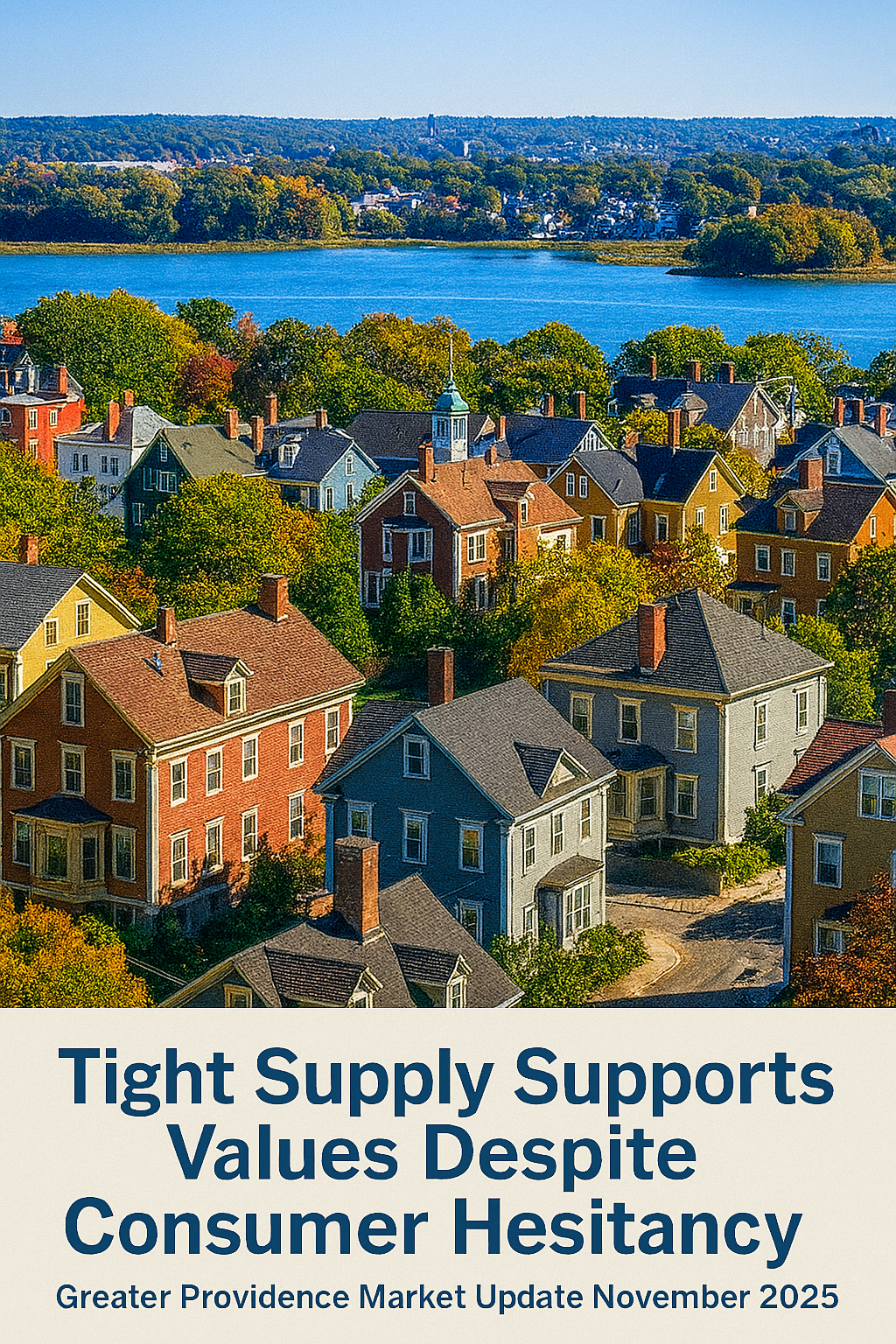

Providence Housing Market: A Resilient Outlook Amid National Trends

For months, we’ve all been hearing about how the housing market is “stuck”—high mortgage rates, affordability challenges, and cautious consumers. Home Depot’s most recent analyst call echoed those themes, pointing to weak housing turnover, consumer uncertainty, and the absence of storm-driven demand as drags on their sales.

But here’s the thing: while those national headwinds are real, Greater Providence continues to show resilience. Let’s break it down.

📉 National Trends That Hit Home

  • Housing Turnover Slows: Across the country, fewer people are buying and selling homes. That means less remodeling, less furnishing, and fewer big-ticket projects.
  • Consumer Caution: Shoppers are deferring discretionary spending. Kitchens, bathrooms, and flooring projects are being put on hold until confidence returns.
  • Storm Activity: Believe it or not, storm seasons drive demand for repairs and rebuilding. A mild season means less of that emergency-driven activity.

📊 Greater Providence Snapshot

  • Inventory: Just 227 homes for sale in late October, with only 86 new listings. Supply is tight.
  • Speed: Homes go pending in about 15 days. Buyers must move fast.
  • Prices: Average home value sits at $419,889, up 1.1% year-over-year. Median sale price in October was $515,000, up 3% YoY.
  • Neighborhoods:
    • College Hill: ~$968,317
    • Downtown: ~$548,504
    • Federal Hill: ~$430,068
    • Valley/Smith Hill: ~$369K–$373K

🧭 What It Means for Buyers & Sellers

  • For Buyers: Yes, rates are high. But inventory is scarce, and homes are still moving quickly. Waiting for the “perfect” rate could mean missing out on the right property.
  • For Sellers: Demand remains strong enough to keep values stable. Homes are selling near list price, often with multiple offers. If you’re considering listing, the market is still in your favor.
  • For Investors: Providence remains attractive as a safe-haven asset. Tight supply and steady demand make real estate here a hedge against broader economic uncertainty.

🔮 Outlook

Nationally, the housing market is in a holding pattern—waiting for lower rates or stronger consumer confidence. Locally, Providence’s severe inventory shortage keeps values resilient. Expect modest price growth (~3.5% in 2026), fast-moving listings, and continued competition in desirable neighborhoods.

Bottom Line: The same forces slowing Home Depot’s sales—cautious consumers, weak turnover, affordability pressures—are shaping our housing market. But in Greater Providence, scarcity keeps the market competitive. If you’re thinking about buying, selling, or investing, the window of opportunity is still open.

Above image and some data generated by AI.

🏡 Five Ways a Government Shutdown Could BENEFIT Real Estate

For the past month or so, “we”, including me, have been talking about all of the ways that the Federal Government Shutdown a/k/a “Schumer Shutdown”, can harm the real estate market. Then my contrarian way of thinking made me wonder: what could be some benefits from the “Schumer Shutdown”? Here goes…

  1. Lower Mortgage Rates Due to Economic Uncertainty
    • Shutdowns often trigger investor anxiety, leading to a flight to safety in U.S. Treasury bonds.
    • This demand pushes bond yields down, which can result in lower mortgage rates, making home loans more affordable.
  2. Reduced Competition from Government-Backed Buyers
    • FHA, VA, and USDA loan processing slows or halts during shutdowns due to furloughs.
    • This can temporarily reduce buyer competition from those relying on government-backed financing, giving conventional buyers an edge.
  3. Price Softening in High-Government Employment Areas
    • Areas with large federal workforces (e.g., D.C., Maryland, Virginia) may see softening demand due to furloughs and lost income.
    • Investors and buyers with cash or stable financing may find discounted opportunities in these markets.
  4. Increased Appeal of Real Estate as a Safe-Haven Asset
    • When the stock market becomes volatile due to political gridlock, some investors shift toward tangible assets like real estate.
    • This can boost demand for income-producing or stable residential properties.
  5. Delayed Economic Data May Stall Rate Hikes
    • Shutdowns often delay key economic reports (e.g., jobs, inflation), which the Federal Reserve uses to guide interest rate decisions.
    • In the absence of data, the Fed may pause rate hikes, keeping borrowing costs lower for longer

That is it…I cannot think of any other “benefits” from the Schumer Shutdown. Can you?

Step-By-Step Guide for Moving Houses and Launching Businesses Successfully

Starting a new business is exciting, but it can also be challenging, especially when you’re also moving homes. If you find yourself in this situation, don’t fret – it’s possible to successfully manage both transitions simultaneously with a bit of planning and organization. In this article shared by Joe Luca, we’ll share some tips to help you make it work.

Shop for Homes Wisely by Determining Your Space Needs

When searching for a new home, it’s essential to determine the amount of space you’ll need to run your business effectively. This includes considering factors such as storage requirements, workspace needs, and any additional equipment or resources that are necessary for your operations. Having a clear idea of how much space you require will help you narrow down your search and focus on properties that meet your specific needs.

Consider Purchasing a Home As-Is to Save Time and Money

If you’re short on time and need to move quickly, consider purchasing a home as-is. These properties may require some renovations or updates, but they can be an excellent option for entrepreneurs who need a move-in-ready office space. Work with real estate professionals like Joe Luca and look for properties that have a designated area for your business, such as a basement, garage, or separate building on the property. Not only will this save you time and money, but it can also allow you to start your business operations sooner rather than later.

Hire a Moving Company

To ensure that your business doesn’t suffer during the move, consider hiring a professional moving company to handle the logistics of the transition. This will free up your time and energy to focus on continuing business operations and maintaining customer relationships. Be sure to communicate your business’s needs and timeline with the moving company so that they can work around your schedule and minimize any disruptions to your operations.

Create a Plan to Stay Organized

To move and start a business at the same time, you need a clear plan and timeline. This will keep you organized and ensure all necessary tasks are completed on schedule. Research potential homes, hire a moving company, set up your office space, and let your customers know about any operational changes. Take it step by step for greater efficiency and ease.

Designate a Space for Your Office

Running a business from home requires separating work and personal life. Choose a designated workspace – a separate room, garage, or shed – to maintain balance. Ensure it’s free from distractions and family activities to stay focused and productive during work hours while still enjoying home life.

Update Your Marketing

Since marketing is the backbone of any business, coming up with effective but affordable ways to spread the word is essential. Luckily, you can market for free via social media – but don’t stop there! You should supplement this with some tried-and-true approaches like business cards, as well. If you aren’t sure how to get started, explore some eye-catching business cards templates that you can customize for free. These are great for providing a tactile reminder of your business to potential clients and customers.

Starting a business and moving at the same time can be overwhelming, but it’s possible to make it work with careful planning and organization. By establishing your space requirements, considering purchasing a home as-is, hiring a professional moving company, using a customer data platform, making a detailed plan and timeline, and choosing a designated workspace, you’ll be well on your way to a successful move and business launch. Remember to take things one step at a time, stay organized, and keep a positive mindset – the rewards of running a thriving business from your dream home are worth it!

Joe Luca is the trustworthy realtor you’ve been looking for. Call (401) 409-5030.

Multi-Family Properties are HOT!

If you want to become a Landlord, The Following May Be Of Interest.

FACTOID #1:  A full 90% of new multifamily construction today is rentals according to one study.

For the last several years, demand in multifamily has outpaced new construction, causing some places to see huge spikes in rent prices. Still demand has not slowed.

FACTOID #2: Multi-Family prices have been growing by up to 8% year-over-year.

Listed below are some of the most important things that today’s tenants are looking for in a rental.

Location

As with any other type of business, the location of your building can, and likely will, have a large impact on the revenue you bring in. Tenants often look for a property that is close to their place of employment, and that offers easy access to grocery stores, restaurants, parks, and more. Tenants are often willing to pay more, or even overlook less than desirable aspects of the unit, in exchange for the quality of lifestyle offered from being in a great neighborhood.  Millennials are attracted to the convenience of advanced technology. They expect that same kind of convenience in their living environments (grocery store within walking distance, public transportation just a few blocks from the apartment, office or workspace accessible by light rail or bus). The more walkable the location, the more attractive it is to young renters.

School District

With more and more consumers choosing to rent, it stands to reason that more families are choosing to rent rather than own. Along with location, tenants are likely looking at the area’s school district, as well. After all, every parent wants the very best for their child — and a safe, quality education is at the top of many parents’ lists.

Parking

Think about it — no one enjoys driving around for an hour looking for a parking spot that’s close to home. While there may be ample parking spaces for your suburban property, parking can be a bit of a challenge in urban areas. If you can’t offer easy off-street parking for your tenants, consider directing your tenants to a parking garage that’s located nearby.

…but not all tenants have cars.

Multi-Modal Transportation Options for Residents

Parking lots are disappearing to make room for more pedestrian friendly options. Most millennials in urban areas do not own cars. They bike, walk, or ride to work. Some high-end multifamily developers are including bike repair and storage “shops” in their buildings or providing ridesharing pickup and drop-off locations on-site.

Convenient On-Site Package Delivery Systems

More than a quarter of the workforce today does not work from an office. Mailing letters or shipping packages usually requires a trip to a FedEx or post office. One amenity attracting young professionals are on-site package delivery systems where packages are received and signed for in real-time through an alert sent to a tenant’s smartphone. Packages can also be sent out from the apartment with pickups scheduled from the apartment’s online platform.

Activities Space and Luxurious Common Areas

Gyms are not the only community spaces tenants want. New developers will need to think about adding an on-site café, workspaces, and lounge areas. Some unique ideas include community gardens and wine tasting rooms, community theaters or apartment pubs or pool halls.

Renovations and Upgrades

Sometimes, the smallest details are the ones that really make a house feel like a home — and that can secure a lease on your space. Upgrades that are smart and strategic, such as hardwood floors or stainless-steel appliances, can help attract higher quality tenants. Other renovations that rank highly among tenants include renovations in the kitchen and bathrooms, updated cabinet hardware, central air conditioning, and a new kitchen backsplash.

Think of these features you offer your tenants as a way of demonstrating to them how you expect to be treated in return — and the care you expect to be given to your building. Even small steps can indicate to your tenants that you really care about the property and that you will be responsive to any necessary property maintenance — always a big concern for renters. By offering these features that tenants are looking for, you are differentiating your property from the competition — allowing you to attract and retain better tenants and enjoy a better return on your investment.

If you have any questions about any of the above information call or text Joe Luca, REALTOR® at 401-580-9797.

The above information was obtained from various web articles published by NAR, CBRE, and NAI Global.

Is NOW A Good Time To Invest In Real Estate?

Timing the market isn’t usually a fruitful endeavor…it’s certainly not rewarding. The decision to invest in rental property should be driven by objective data, not “timing”.

Some things you may want to consider:

  1. Are you personally prepared to be a landlord? “Landlording” isn’t always easy, and it isn’t usually fun. Unlike owning mutual funds, stocks and bonds, it is an active investment. You need to be engaged and committed to being a good Landlord. Unlike the aforementioned, you CAN buy an investment worth five times the amount of money you are committing to the investment by leveraging your investment with a mortgage.
  2. How much money do you have to invest? You need to have enough for a down payment and some reserves for repairs, maintenance, and vacancies.
  3. Will you live in the investment property? This can be a great way to get started if you buy a multi-family.
  4. Will you qualify for a mortgage? Mortgage products for investment properties have different guidelines than mortgages for single family properties.
  5. What are the rental rates in the neighborhoods where you would be looking to invest? Rental rates have been increasing much faster than the cost of ownership nationwide. For example: three rental units generating $3,600/month can support a lot of debt-service, taxes, insurance, and vacancy ratio of 5%. (A $375,000 mortgage with 20% down would have a PITI payment of under $3,000/month at 6.5%.)

While I can’t predict when the next “Crash” is going to occur, it doesn’t appear to be on the horizon based on the empirical data. If it is, and you buy a good property in a good neighborhood, in a desirable town, you will be shielded from the downturn much better than if you bought a property in a not-so-good neighborhood. You will be shielded even more if you are uber-selective with your tenants. Good tenants are almost worth their weight in gold if you compare them to the cost of bad tenants.

Knowledge is power so your best first step may be to have a conversation with an experienced, full-time REALTOR® to assess if investing in real estate is the right “move” for you.

Is Providence, RI Worthy?

The late Mayor Buddy Cianci believed the people of Providence have had a self-esteem problem. Perhaps that should be considered since there are so many “nay-sayers” about new developments in the city.

From http://www.VisitRhodeIsland.com

Providence certainly has “issues” that it needs to deal with. However, so does every other city in the country.
1) ” Traffic is terrible”: Have you driven in Boston recently? Constant changes in traffic patterns, parking is never available where and when you need it, and traffic could mean an hour delay, not a delay of minutes like in Providence.
2) “Providence is too small”: Providence is a boutique city, that is its strength and it should be leveraged. The “mega-conferences” will never come to Providence. Larger cities like Boston, San Francisco, and Chicago have logistical problems with “mega conferences.” (I know because I have gone to those cities for conferences of 20,000.) Providence will never, nor should it, be considered for a “mega conference”.
3) “Where is the money going to come from?”: The money should come from the private sector; no guarantee or loan from any government entity. If an opportunity makes financial sense the big lenders will flock to the opportunity to invest in it. As a REALTOR® with over 20 years’ experience in the commercial sector, I have seen it firsthand. That’s Capitalism and it is very efficient.
4) “Our taxes are too high!”: Tourists and shoppers don’t care about traffic/parking tickets, high taxes, or bureaucratic “red-tape.” They want a good experience. The challenge is for the private sector to put out a product that the consumer wants and will pay for – despite these challenges. CASES-IN-POINT: Walk around Boston, or NYC, or Chicago and observe the parking tickets and “Boots” on vehicles. The afore-mentioned cities have more taxes and they are higher than those in Providence and have more “red-tape.” The consumer may not know or doesn’t care; they just want a good experience.
5) “Good business and high-end consumers won’t come to Providence.”: The city of Providence and many of its detractors and supporters should stop behaving like the city isn’t deserving of “good” businesses, “nice” developments, and “high-end” consumers. Too often, the city is ready to “give away the store.” The city should have Standards and not behave like someone who is so desperate for money that they go to a “pay-day-advance” store. Perhaps that’s the problem. CASES-IN-POINT: Baltimore has had riots and still receives development projects, San Francisco seemingly has a panhandler on every street corner asking for $10 and $20 and people still travel there, political corruption and high shooting and murder rates haven’t hurt Washington DC, Chicago, or New Orleans.

The city of Providence needs to look beyond our city, state, and regional boundaries for solutions. The largest commercial real estate conference in the world is every March in France. Why can’t Providence look to the international community for ideas and funding? There are literally thousands of developers and lenders at this conference looking for real estate investment opportunities. I know because I have attended this for my business and I have met with them. Why shouldn’t we be introducing them to Providence? We should. Would you like to get involved? Message me if you would.

What Should YOU Consider Before You Buy A Property To Flip?

Time. The one factor that many “Fix and Flippers” fail to manage effectively is the time it should take to complete a task (or series of tasks) and the amount of time it actually does take to complete those task(s.) Time IS money, especially when you are borrowing money from a Private or Hard Money Lender.

Extra hours on a few tasks become an added day, an extra day soon pushes into another week, and another week will push into an extra month. That’s another month of interest accruing on your borrowed money, another month of property taxes, another month of vacant property insurance (more expensive,) another month of electricity, heat, etc.

If there is something you don’t know how to do well, hire someone who does. A mistake could cause damage, it will take more time to correct and will cost more money.

Plus, the longer you hold onto a property that you want to sell, the odds (although slim) increase that something could happen and work against you. A weather calamity could damage the house, a winter with snow could prevent laborers from showing up at work, the market could change, and on and on. In short, the longer you unnecessarily hold on to a property the greater the odds become that “if something could go wrong it will.”

Before considering a “flip” you need to have everything buttoned up nice and tight. Your team of tradesmen and laborers must be ready, willing, and available to work for you when you need them to. Make sure that you have access to all of the construction materials that will be necessary.

Know what the market wants and deliver it to them market in a timely fashion. The best way to know the market is to get a full time, experienced REALTOR® in your community. A full time, experienced REALTOR® will have the answers to questions you don’t know to ask; and that will

Lastly, be prepared to manage the project. You must to go to the property twice daily if you are not going to be working yourself. Flipping is not easy but it can be rewarding and gratifying.

Pawtucket Red Sox Moving To Worcester!?!?

I see the relocation of the Paw Sox differently than many Rhode Islanders; in fact, I see this “business relocation” as an opportunity for Rhode Island business and political Leaders to identify and pursue a superior alternative for Pawtucket.  As a Full Time REALTOR® with years of experience in commercial real estate, I believe that McCoy Stadium could be a venue for multiple sports and not remain simply a baseball field.

My opinion is based on the following observations:

  • Public funding of sports venues, aka corporate welfare, is a scam. I believe it is acceptable for businesses to be lured by government entities with tax stabilization plans and/or other incentives.  However, if their business model or  plan, cannot convince private sector lenders to finance their proposed business venture/expansion, perhaps it is flawed, or management/ownership is not  up to the task.
  • The Paw Sox owners demonstrated that they don’t have confidence in their business model without $38 million in government assistance.  As a result, they made a business decision in which the State of Massachusetts will provide $32.5 million and the city has agreed to guarantee the construction debt, meaning it will assure bondholders it can cover any shortfalls if necessary.  The team will pay the Landlord, the City of Worcester, “rent” which comes from revenues.  The State of Rhode Island had a similar arrangement with 38 Studios which didn’t work out well for the tax payers.  This arrangement will increase the bonded indebtedness of the City of Worcester.
  • R.I. has a lot to offer, without giving money away so let’s approach this with some self-confidence and swagger.  R.I. political and business leaders should have no problem getting a replacement, perhaps one who can do it with private-sector funding like Bob Kraft did in Foxboro.  It may take time, but we CAN do it – and we’ll be better off for years to come.

In addition, I would like to share that the Rhode Island Association of REALTORS® (RIAR) has for the past two years participated in MIPIM (www.MIPIM.com), the largest real estate conference in the world.  RIAR has chosen to invest in sending representatives, including yours truly, to explore MIPIM as a viable platform to bring exposure to real estate opportunities for our members, and to broadcast the opportunities Rhode Island has to offer international investors, developers, and businesses.  This conference is attended by over 25,000 real estate professionals from around the world.  Only 248 of them are from the United States so there is significant upside opportunity. There are over 5,000 investors looking for investment opportunities, whether as partners or lenders.  In fact, our colleagues in San Diego established a relationship with an individual lender that yielded development in excess of $100 million in the greater San Diego area.  It took a couple years from start to finish but funding was identified and the deal consummated when there were no stateside lenders who would “step-to-the-plate”.

Rhode Island could benefit greatly from such exposure and relationship-building.  Our cost of living is 20 to30 percent lower than neighboring states, the fiscal health of Rhode Island is superior to Connecticut, we are an hour from Boston and a few hours to New York City.  We also have the internationally recognized City by the Sea. Newport as a gem that is too often overlooked.  Businesses can choose from marine, air, rail or surface transportation for their materials.  Our extensive highway network puts businesses located here within a short drive to the best universities in the world- universities which churn out graduates by the tens of thousands every year, providing a tremendous resource for well-educated employees.  Rhode Island offers a great quality of life that is valued by the hundreds of thousands of tourists who visit us.

Rhode Island has all of this to offer and most of our inhabitants are completely oblivious to these assets, so how can we expect non-Rhode Islanders to know about us and the opportunities our state provides.  That is why we need to trumpet our assets to the rest of the world.  If you look at a map of the United States, it is hard to find Little Rhody even if you know where to look. So, if you are not from here, don’t know where to look, and don’t even know about us, we will be overlooked by our larger neighbors, Boston and NYC.

RIAR has taken the initiative and non-REALTORS® will benefit from our leadership on this issue.  Though I’ve only  attended MIPIM two times, I have established relationships that could be productive for RIAR members and the State of Rhode Island.  We are just one organization and while we will continue our outreach, the State of Rhode Island could use others to trumpet our assets.

The relocation of the Paw Sox IS an opportunity for Rhode Island.  We need to approach it like professionals.  This is NOT a debilitating blow and we should not act like it is.  We need to think back to when the New England Patriots won the Super Bowl over the Atlanta Falcons.  The Patriots were down 21-3 at the half, and then 28-3 at the start of the second half. They did NOT let that overwhelm them. Players and coaches mentally and physically battled back to win. They “did their job” because they are professionals.  Perhaps Rhode Island business and political leaders should look at this as an opportunity to show that we are professionals and we can get  the job done.  So, let this be a “call to arms” to business and political Leaders in the great State of Rhode Island to band together and do our job to market our great state.

GentryMoving                      1st Home Mortgage        REMAX_mastrBalloon_RGB_Rresnick logo


How To Quickly Increase Housing Inventory


Much has been written, spoken, debated, and lamented, about the lack of housing inventory in states from the Northeast, to the Midwest, to the West Coast.  There are myriad reasons and explanations for why, and most of them are probably accurate to some degree.  Many may even help alleviate the pressure on the market to stem the reduction in housing sales.  However, most of these ideas would take time.  While the Free Market is efficient in the long run… it is not necessarily so in the short run. It certainly is not responding quickly to the needs of first time home buyers in the market today.

When I was installed as President of the Rhode Island Association of REALTORS, I called upon my colleagues to Engage, and Inspire others to Engage, in order to remain relevant and productive in our current and ever-changing economy. Now is the time for us to Engage. Politically Engage .  This is also the time we should Inspire others, including consumers, to Engage.  We must inform our legislators and municipal officials that our economy needs to be unbridled by the regulatory restraints that are preventing First Time Home Buyers from participating in the American Dream of Home Ownership.  We have witnessed our national economy quickly rebound, with consecutive fiscal quarters of 3%+ growth, after the federal government eliminated numerous regulations which were restricting economic activity.  Why can that not be done at the state and municipal level so that builders can build houses that lower income families can afford?  Why should “the little guy”, who is too frequently an immigrant, not be able to buy a home because there is nothing available, or nothing is affordable?  This should be not be acceptable in the United States of America.  We must Engage with our legislators and municipal officials, to convince them that it is essential and vital that those at the lower income levels not be precluded from participating in the American Dream of Home Ownership.

As Architects of The American Dream, REALTORS® protect Private Property Rights.  The National Association of REALTORS® is against any obstacles to home ownership:

  • Unnecessary fees to buy a home,
  • Restrictive regulations/policies that infringe on the home-buying process,
  • Restrictive underwriting policies that may “freeze out” some from buying a home,
  • Increasing regulations and fees for consumers to retain ownership,
  • Anything else that may infringe or impede on the home sale process.

REALTORS® need to Engage, and lead the way for consumers to Engage, with the political process. Why shouldn’t everyone that qualifies for a mortgage be able to buy a home?  Why shouldn’t they participate in the American Dream of Home Ownership?  REALTORS® can make it happen so we should make it a reality.  If you want to Engage but don’t know how, email me at JosephLuca@remax.net.

“Transfer of Wealth” – Just for the “Rich”?

Hopefully everyone will have a healthy and prosperous 2018.  It certainly seems to be shaping up that way so far.  The Dow, has broke 26,000, dropped below 25,000 and closed up over 300 points today.  We have experienced well in excess of $1 trillion of new wealth in the stock market in the past twelve months.  That is a good thing.  It is not just the wealthy, the stockbrokers, and other “big shots” that realize this increase in wealth from the stock market.  It is the little guy too.  The laborer/teacher/police officer/fireman who has paid into to a union pension reaps these benefits too.  The pensions invest in the stock market, bonds, real estate and other assets.  As do many mutual funds, some directly and some indirectly.  The word “Wealth” has, in many sectors of society, been erroneously associated with “evil”, “greed”, and other nefarious behavioral traits.  Increasing your wealth is not a bad thing for you, your family and your heirs.  Pretty much everyone wants to make it “easier” for our children to have a better life than we do.  Which brings us to the whole “transfer of wealth” issue.  Full disclosure, I was raised in a family that owned a small business.  My parents, aunts, and uncles all worked hard to assure that their families could be supported by the business.  Was it easy? I don’t think so; trying to sell musical instruments when interest rates were 18% must have been a challenge.  But they did it, they worked hard to increase the value of the business every year.  When the time comes that they pass on they will have the value of their business as a part of their estate. An estate that is composed of assets (typically cash, stocks, bonds, real estate) that are taxed annually.  Why does it make sense that upon their death, the estate should have to pay a tax on these assets yet again? This the government acting like a silent partner, reaping the rewards of decades of hard work without ever participating in the “work” aspect of the business.  So the “wealth” of a small family-owned business will be transferred to the heirs, after the proverbial “pound of flesh” is taken by the government.  We are not talking Kennedy/Rockefeller/Getty wealth, but small time family business “wealth”.  This scenario is repeated millions of times across the country with immigrant families, first and second generation American families, who work hard to build something of value that could be decimated by estate taxes.  This confiscation of wealth is not a good thing. It discourages hard work for the delayed gratification of leaving children and grandchildren in a better financial position than their predecessors. Is that good for America?