
What To Expect When Closing On Your House

If you’re a first‑time homebuyer, or even if it’s been a while since your last purchase, this video will walk you through exactly what to expect on closing day so you can walk in confident and walk out a homeowner.

Let’s start with the basics.

Closing — also called settlement — is the final step in your residential real estate transaction. It’s the moment when:

  • Money changes hands
  • Documents get signed
  • Ownership officially transfers
  • And you get the keys to your new home after the Deed is Recorded

Think of it as the finish line of the home‑buying journey.

Before you even sit down at the closing table, a few important things happen:

1. Final Walkthrough

Usually within 24 hours of closing, you and your agent walk through the property to confirm it’s in the same condition as when you made the offer and that any agreed‑upon repairs were completed.

2. Review Your Closing Disclosure

Your lender must provide this at least three days before closing. It outlines:

  • Your loan terms
  • Closing costs
  • Prepaid taxes and insurance
  • Cash needed to close

Review it carefully — this is your chance to ask questions before signing anything.

Now let’s talk about what actually happens during the closing appointment.

You’ll Sign Documents

A lot of them. These include:

  • The promissory note
  • The mortgage or deed of trust
  • The settlement statement
  • Various disclosures required by state and federal law

You’ll Bring Your Funds to Close

This is usually done via certified funds or wire transfer. No personal checks.

The Title Company or Attorney Finalizes Everything

They’ll:

  • Verify your identity
  • Confirm the lender has funded the loan
  • Record the deed with the city or town
  • Issue your title insurance policies

Once everything is signed and recorded… you’re officially the owner.

After closing, you’ll receive copies of your documents — either digitally or in a physical folder.

You’ll also get:

  • Your keys
  • Garage door openers
  • Any appliance manuals
  • And sometimes a welcome packet from the seller

From here, you can move in, change the locks, and start making the home your own.

If you found this helpful, please subscribe for more real estate tips, homebuyer education, and Rhode Island market insights.

If you’re thinking about buying or selling a home — or you want to understand the closing process in more detail — reach out anytime. I’m here to guide you every step of the way.

Thanks for reading, and congratulations in advance on your closing day.

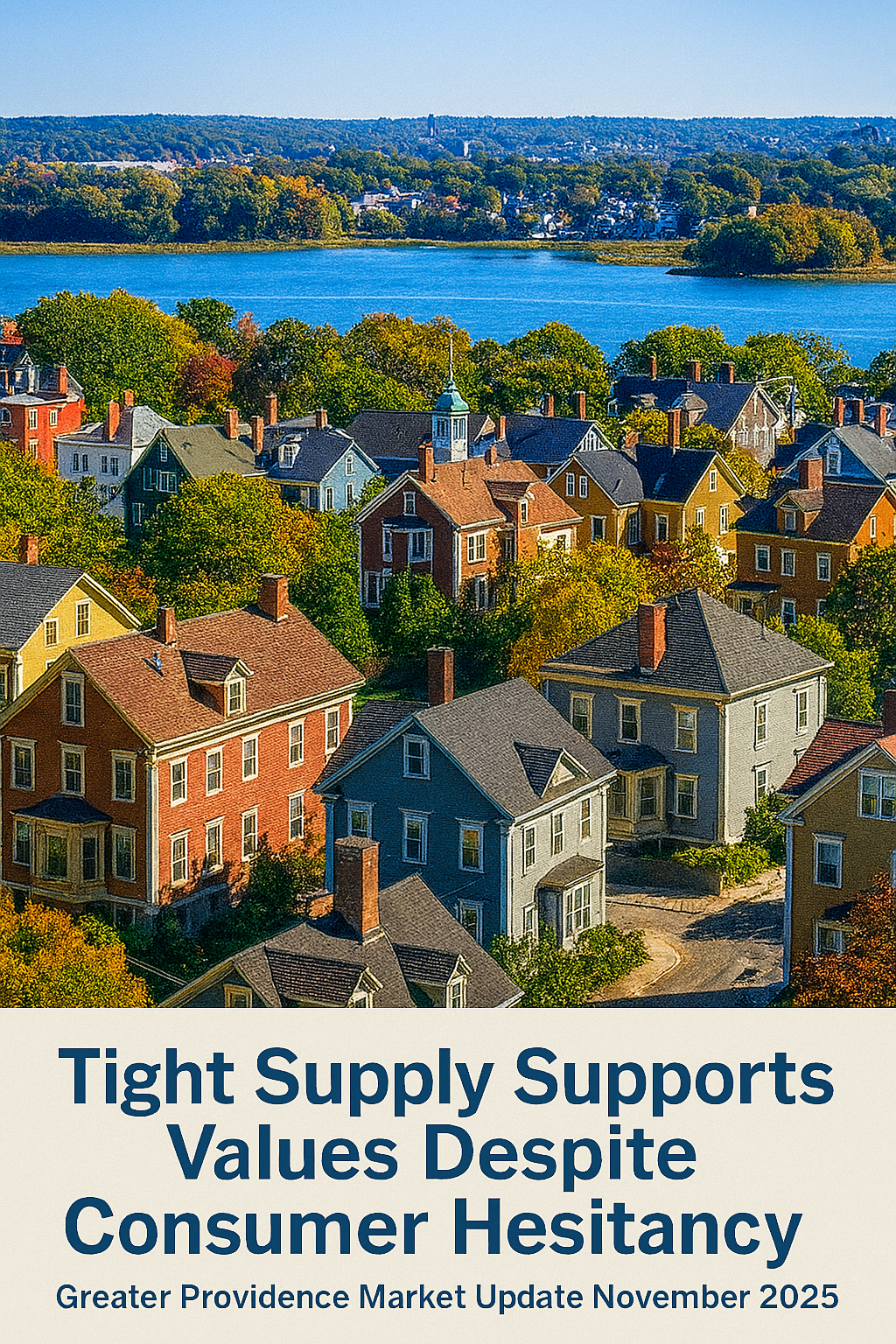
Providence Housing Market: A Resilient Outlook Amid National Trends

For months, we’ve all been hearing about how the housing market is “stuck”—high mortgage rates, affordability challenges, and cautious consumers. Home Depot’s most recent analyst call echoed those themes, pointing to weak housing turnover, consumer uncertainty, and the absence of storm-driven demand as drags on their sales.

But here’s the thing: while those national headwinds are real, Greater Providence continues to show resilience. Let’s break it down.

📉 National Trends That Hit Home

  • Housing Turnover Slows: Across the country, fewer people are buying and selling homes. That means less remodeling, less furnishing, and fewer big-ticket projects.
  • Consumer Caution: Shoppers are deferring discretionary spending. Kitchens, bathrooms, and flooring projects are being put on hold until confidence returns.
  • Storm Activity: Believe it or not, storm seasons drive demand for repairs and rebuilding. A mild season means less of that emergency-driven activity.

📊 Greater Providence Snapshot

  • Inventory: Just 227 homes for sale in late October, with only 86 new listings. Supply is tight.
  • Speed: Homes go pending in about 15 days. Buyers must move fast.
  • Prices: Average home value sits at $419,889, up 1.1% year-over-year. Median sale price in October was $515,000, up 3% YoY.
  • Neighborhoods:
    • College Hill: ~$968,317
    • Downtown: ~$548,504
    • Federal Hill: ~$430,068
    • Valley/Smith Hill: ~$369K–$373K

🧭 What It Means for Buyers & Sellers

  • For Buyers: Yes, rates are high. But inventory is scarce, and homes are still moving quickly. Waiting for the “perfect” rate could mean missing out on the right property.
  • For Sellers: Demand remains strong enough to keep values stable. Homes are selling near list price, often with multiple offers. If you’re considering listing, the market is still in your favor.
  • For Investors: Providence remains attractive as a safe-haven asset. Tight supply and steady demand make real estate here a hedge against broader economic uncertainty.

🔮 Outlook

Nationally, the housing market is in a holding pattern—waiting for lower rates or stronger consumer confidence. Locally, Providence’s severe inventory shortage keeps values resilient. Expect modest price growth (~3.5% in 2026), fast-moving listings, and continued competition in desirable neighborhoods.

Bottom Line: The same forces slowing Home Depot’s sales—cautious consumers, weak turnover, affordability pressures—are shaping our housing market. But in Greater Providence, scarcity keeps the market competitive. If you’re thinking about buying, selling, or investing, the window of opportunity is still open.

Above image and some data generated by AI.

50-Year and Portable Mortgages

50-Year Mortgages: Would I Recommend One?

Would I recommend a 50-year mortgage to my daughter, who is currently renting? Honestly, building equity with such a loan would be slow. Fully owning the property free-and-clear could take a lifetime—or even longer. On top of that, the interest rate on a 50-year mortgage would almost certainly be higher. It would be higher than on a traditional 30-year loan.

That said, I wouldn’t outright oppose it. Here’s why.

Why a 50-Year Mortgage Might Make Sense

  • Lower monthly payments: Even modest reductions can make a difference in qualifying ratios.
  • Fixed payments vs. rising rents: Mortgage payments stay the same, while rents inevitably increase over time.
  • Automatic equity through appreciation: Home price gains build equity regardless of the mortgage balance.
  • Flexibility to pay down faster: Extra payments from raises or bonuses can shorten the payoff timeline significantly.
  • Future refinancing or trading up: Homeowners have options if rates decline. They can refinance into shorter terms. Alternatively, they can move into a new property with a better loan structure.

In short, while the 50-year mortgage is far from perfect, it can serve as a stepping stone into homeownership. It is beneficial for renters who might otherwise remain on the sidelines.

Assumable and Portable Mortgages: Pros and Cons

We’re considering unconventional mortgage structures. It’s worth exploring assumable and portable mortgages. These two ideas could reshape affordability if implemented more widely.

Assumable Mortgages

An assumable mortgage allows a buyer to take over the seller’s loan under its original terms. Imagine assuming a 30-year fixed loan from January 2021 at 2.65%. Compare that to today’s rates north of 6%, and the appeal is obvious.

The Catch

  • Equity gap: Buyers must cover the difference between the home’s current value and the remaining loan balance. Often this requires a second mortgage at a higher rate.
  • Approval hurdles: Lenders must approve the assumption, and buyers must meet financial qualifications.
  • Seller liability: Unless formally released, sellers may remain liable for the loan even after transferring it.

Government-backed loans (FHA, VA, USDA) are generally assumable, but conventional loans rarely are.

Potential Improvements

  • Expanding assumability to Fannie Mae and Freddie Mac loans.
  • Offering low-cost “top-up” loans to bridge equity gaps.
  • Educating consumers and professionals to normalize the practice.

Still, the government can’t retroactively make existing non-assumable loans assumable. That ship has sailed for the ultra-low-rate loans of 2020–2022.

Portable Mortgages

A portable mortgage allows borrowers to transfer their existing loan to a new property. This concept is common in the UK but rare in the U.S.

Benefits

  • Keeps the borrower’s low interest rate intact when moving.
  • Reduces the need to start fresh with higher-rate financing.

Challenges

  • Requires a new mortgage application with full underwriting.
  • Borrowers must cover the gap between the new home’s price and the existing loan balance.
  • U.S. lenders may resist, since they profit from “churn” in mortgage origination.

The Bigger Picture

Both assumable and portable mortgages offer intriguing ways to ease affordability pressures. But they face significant hurdles—legal, financial, and political.

Meanwhile, the 50-year mortgage proposal has already sparked debate. Lawrence Yun is the chief economist for the National Association of Realtors®. He warns that the “small savings” in monthly payments come with “significant trade-offs.” Slow equity build makes trading up difficult. Meaningful equity may not arrive until the final decade of the loan.

Ultimately, subsidizing demand without increasing supply risks pushing home prices even higher. The only true solution to the housing crisis is simple, though not easy: build millions more affordable homes.

Takeaway for Renters and Buyers: A 50-year mortgage isn’t ideal, but it can be a gateway to homeownership. Assumable and portable mortgages could help in theory, but they’re far from mainstream in practice. For now, the smartest path remains balancing affordability with flexibility. This involves buying when ready. It also means paying down aggressively when possible and staying alert to refinancing opportunities.

📣 If you’re weighing your options in today’s complex housing market, don’t go it alone. Whether you’re a renter considering your first purchase, I’m here to help. If you’re a homeowner exploring refinancing, I’m here to help. Perhaps you are simply curious about how these evolving mortgage products could impact your future, I’m here to help.

👉 Subscribe to my newsletter for practical insights. Tune into The Joe Luca Real Estate Show on Tuesdays at 6pm EST at WNRI.com, for weekly updates. You can also reach out directly to discuss your personal situation. Together, we can cut through the noise and chart a clear path toward smart, sustainable homeownership.

This post was created with information from Lawrence Yun at NAR.com, Realtor.com, Bloomberg.com and Kiplinger.com.

Why Now Is a Great Time to Buy a House in Southern New England

If you’ve been dreaming of owning a home in Southern New England—think Connecticut’s charming towns, Rhode Island’s coastal gems, or the historic corners of southern Massachusetts—2025 might be your moment. As of March 11, 2025, the real estate market here is showing signs of opportunity for buyers. From economic shifts to local trends, here’s why now could be the perfect time to plant your roots in this picturesque region.

1. Interest Rates Are Settling Down

After a wild ride in recent years, mortgage rates appear to be stabilizing across the U.S., and Southern New England is no exception. While we’re not back to the rock-bottom rates of the 2010s, the steep climbs of the early 2020s have eased. For buyers in places like New Haven or Providence, this means more predictable mortgage payments and a chance to lock in a rate before any surprises. With the Federal Reserve keeping a close eye on inflation, rates could hold steady—giving you a solid window to finance that Cape Cod-style home or colonial fixer-upper.

2. Inventory Is Ticking Up Across the Region

Southern New England has felt the inventory crunch hard, with sellers clinging to their low-rate mortgages or waiting out peak prices. But early 2025 is bringing a shift. In towns like Mystic, CT, or Bristol, RI, more “For Sale” signs are popping up. Maybe it’s empty nesters downsizing, retirees heading south, or homeowners feeling the market has topped out. Whatever the reason, this uptick means more choices—whether you’re eyeing a waterfront cottage in Narragansett or a suburban spread in West Hartford. More options also mean less cutthroat bidding wars, a welcome relief for buyers.

3. Prices Are Softening in Hotspots

The pandemic boom sent prices soaring in Southern New England, especially in desirable spots like Fairfield County or the South Shore of Massachusetts. But as demand normalizes, some of these overheated markets are cooling. Sellers who bought at the 2021 peak might be more open to negotiation, especially in areas where listings are lingering a bit longer. In places like Cranston, RI, or Milford, CT, you could snag a deal that feels more reasonable than it did two years ago. It’s not a buyer’s market everywhere, but the balance is tipping your way in many towns.

4. Southern New England’s Long-Term Appeal Holds Strong

This region’s charm—historic villages, top-notch schools, and proximity to both Boston and New York—makes it a perennial winner for real estate investment. Even with short-term ebbs and flows, home values here tend to climb over time. Buying now in, say, Portsmouth, RI, or Simsbury, CT, sets you up for equity growth as hybrid work trends keep the area attractive to professionals and families alike. A home purchased in 2025 could be your family’s cornerstone—and a financial win—by 2035.

5. Local Incentives Are Sweetening the Deal

From builders in growing suburbs like Plainfield, CT, to sellers in competitive markets like Attleboro, MA, incentives are emerging. New developments might offer rate buydowns or closing cost help, while individual sellers could throw in extras—like covering roof repairs or offering flexible move-in dates—to close the deal. These perks can shave thousands off your upfront costs, making homeownership more attainable in a region where prices can still feel steep.

6. Seasonal Timing Works in Your Favor

March in Southern New England is a quiet season for real estate. The spring rush hasn’t fully kicked in, and winter’s chill keeps some buyers indoors. That means less competition as you tour that farmhouse in Litchfield County or that bungalow in Westerly, RI. Sellers listing now might be extra motivated—perhaps they’re relocating for work or eager to sell before the summer crowd arrives. It’s a strategic moment to strike while the market’s still waking up.

A Word of Caution

Southern New England’s market varies widely—Greenwich, CT, is a different beast from Fall River, MA. Check local trends, get pre-approved, and team up with a realtor who knows the area inside out. Coastal properties might still carry flood insurance costs, and older homes could need TLC. But for those ready to navigate these quirks, the rewards are there.

The Bottom Line

March 2025 is shaping up as a buyer’s sweet spot in Southern New England. With steadier rates, growing inventory, softening prices in key areas, and the region’s enduring appeal, the stars are aligning. So, grab your map, hit the open houses—from Stamford to Stonington—and make your move. That quintessential New England home, complete with a front porch and autumn leaves, might be waiting for you right now.

If you have any questions, or would like to connect, email me: Joe@JoeLucacaRealtor.com

Step-By-Step Guide for Moving Houses and Launching Businesses Successfully

Starting a new business is exciting, but it can also be challenging, especially when you’re also moving homes. If you find yourself in this situation, don’t fret – it’s possible to successfully manage both transitions simultaneously with a bit of planning and organization. In this article shared by Joe Luca, we’ll share some tips to help you make it work.

Shop for Homes Wisely by Determining Your Space Needs

When searching for a new home, it’s essential to determine the amount of space you’ll need to run your business effectively. This includes considering factors such as storage requirements, workspace needs, and any additional equipment or resources that are necessary for your operations. Having a clear idea of how much space you require will help you narrow down your search and focus on properties that meet your specific needs.

Consider Purchasing a Home As-Is to Save Time and Money

If you’re short on time and need to move quickly, consider purchasing a home as-is. These properties may require some renovations or updates, but they can be an excellent option for entrepreneurs who need a move-in-ready office space. Work with real estate professionals like Joe Luca and look for properties that have a designated area for your business, such as a basement, garage, or separate building on the property. Not only will this save you time and money, but it can also allow you to start your business operations sooner rather than later.

Hire a Moving Company

To ensure that your business doesn’t suffer during the move, consider hiring a professional moving company to handle the logistics of the transition. This will free up your time and energy to focus on continuing business operations and maintaining customer relationships. Be sure to communicate your business’s needs and timeline with the moving company so that they can work around your schedule and minimize any disruptions to your operations.

Create a Plan to Stay Organized

To move and start a business at the same time, you need a clear plan and timeline. This will keep you organized and ensure all necessary tasks are completed on schedule. Research potential homes, hire a moving company, set up your office space, and let your customers know about any operational changes. Take it step by step for greater efficiency and ease.

Designate a Space for Your Office

Running a business from home requires separating work and personal life. Choose a designated workspace – a separate room, garage, or shed – to maintain balance. Ensure it’s free from distractions and family activities to stay focused and productive during work hours while still enjoying home life.

Update Your Marketing

Since marketing is the backbone of any business, coming up with effective but affordable ways to spread the word is essential. Luckily, you can market for free via social media – but don’t stop there! You should supplement this with some tried-and-true approaches like business cards, as well. If you aren’t sure how to get started, explore some eye-catching business cards templates that you can customize for free. These are great for providing a tactile reminder of your business to potential clients and customers.

Starting a business and moving at the same time can be overwhelming, but it’s possible to make it work with careful planning and organization. By establishing your space requirements, considering purchasing a home as-is, hiring a professional moving company, using a customer data platform, making a detailed plan and timeline, and choosing a designated workspace, you’ll be well on your way to a successful move and business launch. Remember to take things one step at a time, stay organized, and keep a positive mindset – the rewards of running a thriving business from your dream home are worth it!

Joe Luca is the trustworthy realtor you’ve been looking for. Call (401) 409-5030.

Home Ownership – A Great Hedge Against The Impact Of Rising Inflation

If you’re following along with the news today, you’ve heard about rising inflation. Today, inflation is at a 40-year high. According to the National Association of Home Builders (NAHB):

“Consumer prices accelerated again in May as shelter, energy and food prices continued to surge at the fastest pace in decades. This marked the third straight month for inflation above an 8% rate and was the largest year-over-year gain since December 1981.”

With inflation rising, you’re likely feeling it impact your day-to-day life as prices go up for gas, groceries, and more. These climbing consumer costs can put a pinch on your wallet and make you re-evaluate any big purchases you have planned to ensure they’re still worthwhile.

If you’ve been thinking about purchasing a home this year, you’re probably wondering if you should continue down that path or if it makes more sense to wait. While the answer depends on your situation, here’s how homeownership can help you combat the rising costs that come with inflation.

Homeownership Helps You Stabilize One of Your Biggest Monthly Expenses

Investopedia explains that during a period of high inflation, prices rise across the board. That’s true for things like food, entertainment, and other goods and services, even housing. Both rental prices and home prices are on the rise. So, as a buyer, how can you protect yourself from increasing costs? The answer lies in homeownership.

Buying a home allows you to stabilize what’s typically your biggest monthly expense: your housing cost. When you have a fixed-rate mortgage on your home, you lock in your monthly payment for the duration of your loan, often 15 to 30 years. James Royal, Senior Wealth Management Reporter at Bankratesays:

A fixed-rate mortgage allows you to maintain the biggest portion of housing expenses at the same payment. Sure, property taxes will rise and other expenses may creep up, but your monthly housing payment remains the same. That’s certainly not the case if you’re renting.”

So even if other prices increase, your housing payment will be a reliable amount that can help keep your budget in check. If you rent, you don’t have that same benefit, and you won’t be protected from rising housing costs.

Investing in an Asset That Historically Outperforms Inflation

While it’s true rising home prices and higher mortgage rates mean that buying a house today costs more than it did even a few months ago, you still have an opportunity to set yourself up for a long-term win. That’s because, in inflationary times, you want to be invested in an asset that outperforms inflation and typically holds or grows in value.

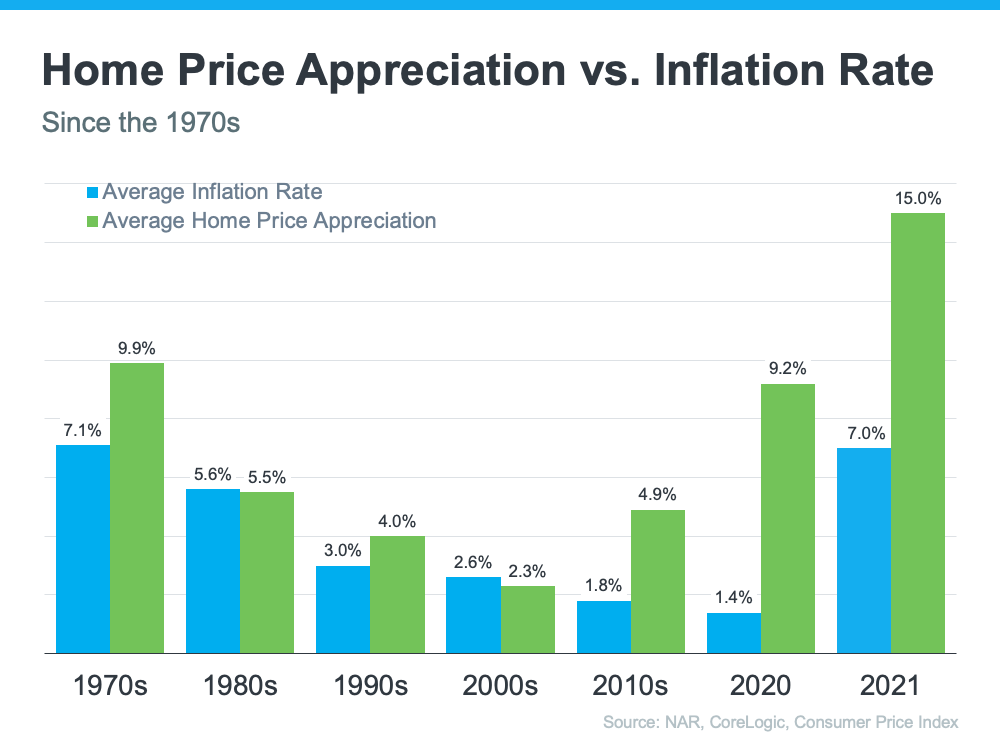
The graph below shows how the average home price appreciation outperformed the average inflation rate in most decades going all the way back to the seventies – making homeownership a historically strong hedge against inflation (see graph below):

Homeownership Is a Great Hedge Against the Impact of Rising Inflation | MyKCM

So, what does that mean for you? Today, experts forecast home prices will only go up from here thanks to the ongoing imbalance of supply and demand. Once you buy a house, any home price appreciation that does occur will grow your equity and your net worth. And since homes are typically assets that grow in value, you have peace of mind that history shows your investment is a strong one.

That means, if you’re ready and able, it makes sense to buy today before prices rise further.

Bottom Line

If you’ve been thinking about buying a home this year, it makes sense to act soon, even with inflation rising. That way you can stabilize your monthly housing cost and invest in an asset that historically outperforms inflation. If you’re ready to get started, let’s connect so you have expert advice on your specific situation when you’re ready to buy a home.

« Things To Avoid After Applying for a Home Loan

The information contained, and the opinions expressed, in this article are not intended to be construed as investment advice. Keeping Current Matters, Inc. does not guarantee or warrant the accuracy or completeness of the information or opinions contained herein. Nothing herein should be construed as investment advice. You should always conduct your own research and due diligence and obtain professional advice before making any investment decision. Keeping Current Matters, Inc. will not be liable for any loss or damage caused by your reliance on the information or opinions contained herein.Search

Categories

We believe every family should feel confident when buying and selling a home.

RELATIONSHIPS AND REAL ESTATE

A REALTOR’s® Relationships with Colleagues, Partners and Vendors Can Save a Transaction.

A REALTOR’s® job (in a nutshell) is to procure the sale of real estate between a willing buyer and seller.

We have all been part of, or witnessed, a transaction that does not go well.  Whether it is buying/leasing a car, or retaining the services of a contractor, unless the parties are successful in communicating extremely clearly, there is always a possibility for a “miscommunication”.  This can lead to wounded egos, unhappy parties, or an issue to be resolved by litigation.  Can a Relationship save a transaction?

My relationship with my network is essential to client-satisfaction.  Whether referring a client to another REALTOR® a thousand miles away, or a local lender, I have extreme confidence in my referral partners.  When you are looking for a REALTOR® to partner with, it is essential that he/she have strong relationships with their referral network.

As a Full-Time REALTOR® for over a decade, I am fortunate that I have not had anything worse than the “wounded ego” (mine) experience in my business.  Live-and-
Learn.  One of the ways I have virtually eliminated the chance of these types of “miscommunications” is by putting all important communications in writing.  Additionally, I am very selective when choosing business partners and vendors to whom I refer business.  My partners and vendors are full-time (so they aren’t distracted by another job,) professional (they conduct themselves and behave appropriately,) ethical (they don’t put anything in front of the client’s best interests,) and licensed, and insured.  Having established relationships with people of this caliber, reduces the chance a client will be unhappy with me, because of an experience they had with a referral partner.

My colleagues who are also at the top of their game usually have strong networks of referral partners that they rely on for their clients’ needs. 

There are lots of good REALTORS®, but what sets some apart is the strength of the relationships they have with their referral network.  There have been times when I have to request that a partner, or vendor, to go the “extra (ethical) mile” to help bring a transaction to the Closing Table.  Maybe it is as simple as asking my preferred moving company to squeeze in an extra moving job for a client who scheduled a move with another mover whose truck broke down, or calling North Smithfield Tree Service to remove tree limbs that the Seller couldn’t get removed and it’s the day before Closing. 

The difference between success and failure maybe the extra effort exerted as a result of a relationship between the REALTOR® and a someone in their network.   

That is why Relationships are essential in the business of Real Estate.  YES, a relationship CAN save a transaction.

Joe Luca is a full-time REALTOR® who helps buyers and sellers achieve their real estate goals.

Why Should I Work With a REALTOR®?

Not all real estate practitioners (Licensees) are REALTORS®. The term REALTOR® is a registered trademark that identifies a real estate professional who is a member of the NATIONAL ASSOCIATION of REALTORS® and subscribes to its strict Code of Ethics.  REALTORS® are required to do more than comply with the law; REALTORS® must conduct themselves in an ethical, professional manner in all dealings with colleagues and consumers.

Here are several reasons why it pays to work with a REALTOR®.

  1. You’ll have an expert to guide you through the process. Buying or selling a home usually requires disclosure forms, inspection reports, mortgage documents, insurance policies, deeds, and multi-page settlement statements. A knowledgeable expert will help you prepare the best deal, and avoid delays or costly mistakes.
  2. Get objective information and opinions. REALTORS® can provide local community information on utilities, zoning, schools, and more. They’ll also be able to provide objective information about each property. A professional will be able to help you answer these two important questions: Will the property provide the environment I want for a home or investment? Second, will the property have resale value when I am ready to sell?
  3. Find the best property out there. Sometimes the property you are seeking is available but not actively advertised in the market, and it will take some investigation by your REALTOR® to find all available properties.housing
  4. Benefit from their negotiating experience. There are many negotiating factors, including but not limited to price, financing, terms, date of possession, and inclusion or exclusion of repairs, furnishings, or equipment. In addition, the purchase agreement should provide a period of time for you to complete appropriate inspections and investigations of the property before you are bound to complete the purchase. Your agent can advise you as to which investigations and inspections are recommended or required.
  5. Property marketing power. Real estate doesn’t sell due to advertising alone. In fact, a large share of real estate sales comes as the result of a practitioner’s contacts through previous clients, referrals,

    Remax BannerOutstandingAgents
    Enter a caption

    friends, and family. When a property is marketed with the help of a REALTOR®, you do not have to allow strangers into your home. Your REALTOR® will generally prescreen and accompany qualified prospects through your property.

  6. Real estate has its own language. If you don’t know a CMA from a PUD, you can understand why it’s important to work with a professional who is immersed in the industry and knows the real estate language.
  7. REALTORS® have done it before. Most people buy and sell only a few homes in a lifetime, usually with quite a few years in between each purchase. And even if you’ve done it before, laws and regulations change. REALTORS®, on the other hand, handle hundreds of real estate transactions over the course of their career. Having an expert on your side is critical.
  8. Buying and selling is an emotional process. A home often symbolizes family, rest, and security — it’s not just four walls and a roof. Because of this, home buying and selling can be an emotional undertaking. And for most people, a home is the biggest purchase they’ll ever make. Having a concerned, but objective, third party helps you stay focused on both the emotional and financial issues most important to you.
  9. Ethical treatment. Every member of the NATIONAL ASSOCIATION of REALTORS® makes a commitment to adhere to a strict Code of Ethics, which is based on professionalism and protection of the public. As a customer of a REALTOR®, you can expect honest and ethical treatment in all transaction-related matters. It is mandatory for REALTORS® to take the Code of Ethics orientation and they are also required to complete a refresher course every four years
  10. Relationships. Real Estate is a relationship-driven business.  Experienced, Full-Time REALTORS® have relationships with licensed, insured, experienced, practitioners in many different parts of the business: Home Inspectors, Moving Companies, Plumbers, Electricians, Painters, Fencing Companies, Attorneys, and more.  You won’t have to worry about finding someone, your REALTOR® can refer them to you!

Success: red graph over coins

Additionally, Full-Time, Experienced REALTORS® understand the market; they work with Buyers so they know what Buyers like and dislike, and they know what “competition” is on the market.  Full-Time, Experienced REALTORS® know Millennials (The Largest Generation of Home-Buyers in history) have different expectations than Gen X’ers and Boomers.  Each group has different needs, wants, values, and ways of communicating during the buying process.

Last, but not least important, is Safety.  Your home, or you, can be seen as an “opportunity” by individuals with bad intentions.  REALTORS®, especially Full-Time, Experienced ones, are trained in how to minimize your exposure to situations which could compromise you and your family’s safety.

So, why should you work with a REALTOR®? If you want to buy or sell a home on YOUR schedule, with minimal stress and surprises, and receive more value from the transaction (buy lower, sell higher) you should hire a Full-Time REALTOR®

Here are a few of our Preferred Partners:

1st Home Mortgage
John Dolbec Team (401) 266-4413

NationsLending2
Don Miller (401) 241-9676

northpointe-bank
Matt Resnick 401-439-5240

shamrock-website-logo-2
Suzanne Caldeira Team 401-228-9565

Bank of england mortgage
Anthony Senerchia Jr (401) 385-3630, Ext. 109

greenhomesolutions
Dan Anderson  401-871-3335

GentryMoving
Brian Crum 401-500-2925

50 Years Of Fair Housing

April 11 marks the 50th anniversary of the signing of the federal Fair Housing Act. Why is the commemoration a top priority for the National Association of REALTORS®?
The right to own property, and to own a home, is the foundation of our business.

NAR has taken an active role in promoting, and educating REALTORS® about, equal housing opportunity for 50 years.


The Fair Housing Act prohibits discrimination based on race, color, national origin, religion, sex, familial status, or disability.
NAR incorporates all of those requirements, as well as equal opportunity on the basis of sexual orientation and gender identity, into our REALTORS® Code of Ethics, because it makes our association, our industry, and our country stronger.

FAIR Housing Commemoration


NAR’s commemoration of the Fair Housing Act is vital because it highlights how far we’ve come in promoting equal housing opportunity—both as a society and as an association—and, more importantly, that our work is on-going.
When Title VIII of the Civil Rights Act was passed in 1968, many in organized real estate had a far different view of fair housing. The new era of openness and equality in the sale or rental of housing clashed with hardwired beliefs at that time; and many believed that fair housing law posed a threat to individual property rights.

President Lyndon Johnson, as he signed the Fair Housing Act on April 11, 1968, famously declared that the right to fair housing “is now a part of the American way of life.”
That right also became every REALTOR®’s responsibility. For all the progress made to raise awareness and end discriminatory practices, as specified in the law and the REALTORS® Code of Ethics, the challenges for the industry and society persist. Fifty years later, REALTORS® commitment to upholding the principles of fair housing remains a top priority.

Despite all of the strides that have been made in Fair Housing, we must learn from the past. Housing is not a special interest; it is a human right. NAR and the RI Association of REALTORS® is committed to safeguarding this right.

Our vigilance must continue so that future generations may also enjoy the benefits of Fair Housing.

Some areas of concern include:

1. How to avoid Steering claims in the age of big data;
2. How emotional support animals like therapy dogs are finding their way into fair housing law;
3. Illegal discrimination based on familial status.
While we may not be able to predict the adversity of our society, or the challenges of the market place, in the future, we must always work together as a nation, and as REALTOR® professionals, to protect the right of Fair Housing for ALL who live here in the greatest country on earth.